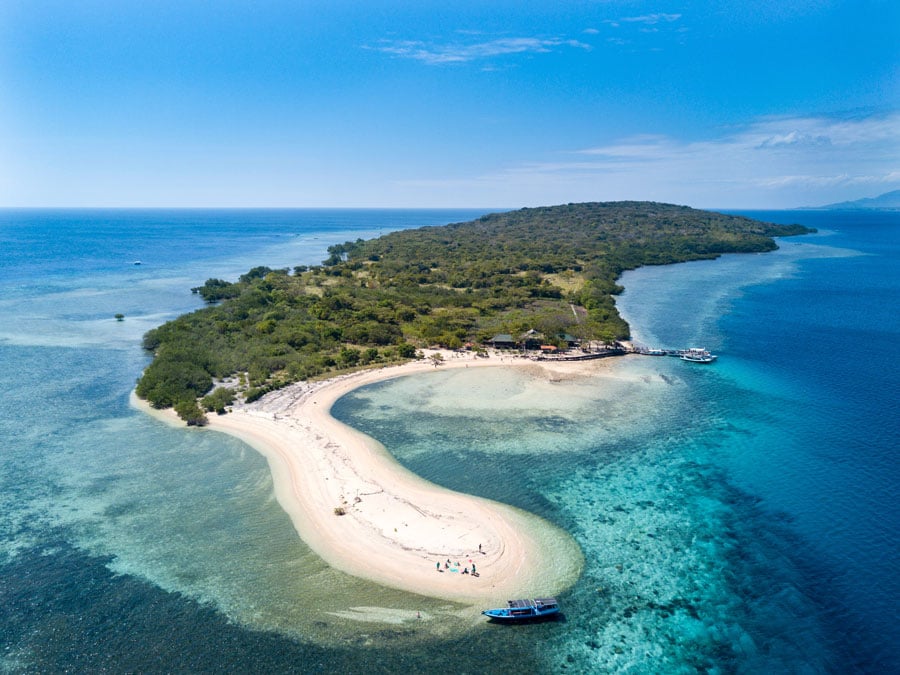
Menjangan is a small uninhabited island off the north-west coast of Bali, inside West Bali National Park. You reach it by boat, spend a few hours there and come back — there is nowhere to stay on it. This is what a trip actually involves.
The island
Menjangan means deer in Javanese, and the island is named for the rusa deer that live on it. There is a temple on the north side and a large Ganesha statue visible from the water; most visitors see both from the boat without landing.
The island itself is small and dry, and it is not the reason to come. The reason is underneath it: a fringing reef that drops into a wall a short distance from shore, protected since the park was declared, in the clearest water in Bali.
Getting there
Boats leave from two places. Labuhan Lalang is the harbour inside the national park and the shorter crossing, about half an hour. Pemuteran, twenty minutes east along the coast, has most of the accommodation and most of the dive centres, and its boats take a little longer.
From the south of Bali the drive is three to four hours each way, so Menjangan is realistically an overnight trip rather than a day out. Most people stay in Pemuteran.
What a trip looks like
Trips leave in the morning, when the water is calmest. A half day covers two sites and has you back by early afternoon. A full day adds a third and includes lunch, usually on the island or on the boat.
Divers get two dives on a half day and three on a full day. Divers and snorkellers normally share the same boat and the same sites, which makes a mixed group straightforward to arrange.
Diving
Menjangan is a wall dive, and that is the whole appeal. The reef edge drops from about three metres to well past forty, hung with sea fans, barrel sponges and soft coral, with overhangs and small caves cut into it. You swim along the wall rather than down it, so depth is a choice rather than a requirement.
That makes it unusually forgiving. Currents on the sheltered side are mild and visibility is high, so a newly qualified diver can dive the same wall as someone with several hundred logged dives, just shallower. Named sites include the Eel Garden, the Anchor Wreck and the Pos points along the north side.
You need a current certification to dive. Operators will ask for your card and logbook, and may require a check dive if you have not been in the water for a while. For anyone without a certification, introductory dives run in the shallows under direct supervision.
Snorkelling
Because the wall begins so close to the surface, snorkellers see a great deal of what divers see. The shallow gardens sit in three to five metres of water with the drop-off running alongside them. It suits beginners and children, and the boats carry vests. Our snorkelling guide covers the individual sites in more detail.
What it costs, and what is included
Prices depend on the operator, the size of the group and whether you are diving or snorkelling. The inclusions matter more than the headline figure, and they vary: the national park fee, the marine conservation fee, equipment, lunch and the transfer from your accommodation are each sometimes in and sometimes out. We quote them itemised so that two prices can actually be compared.
When to go
April to October, with visibility usually best in September and October. From November to March crossings are called off when the wind is up, so leave a spare day if the trip is the reason you came this far.
What to bring
- Swimwear and a rash vest — more useful than sunscreen for a long morning on the water.
- Reef-safe sunscreen, a hat and a towel.
- Cash in rupiah for park fees, if they are not included in what you have booked.
- Certification card and logbook, if you are diving.
- Seasickness tablets if the crossing worries you, taken before boarding rather than after.
- A dry bag. Boats are open and everything on them gets wet.
Who runs these trips
The boats and dive centres at Labuhan Lalang and Pemuteran are independent local operators. We are not one of them. We work with several, and book whichever suits the group, the date and the conditions on the day — and if you would rather use a particular operator, ask and we will arrange it.
Common questions
Do I have to dive to make the trip worthwhile?
No. The wall starts within a few metres of the surface, so snorkellers see the drop-off, the coral and most of the fish. Menjangan is one of the few places where snorkelling is not the lesser version of the day.
Can a newly qualified diver dive here?
Yes, and many do. Mild currents, high visibility and a wall you can swim along at any depth make it a common choice for a first dive trip after qualifying.
Is it suitable for children?
For snorkelling, yes, with a vest and in calm conditions. Dive centres set their own minimum ages for diving, so ask when booking.
How rough is the crossing?
Usually calm in the morning during the dry season. It can be choppy later in the day and in the wet season, which is why trips leave early.
Can I do it as a day trip from Seminyak or Ubud?
Not sensibly. It is three to four hours each way before the boat, and the boat goes in the morning. Stay a night on the north-west coast.